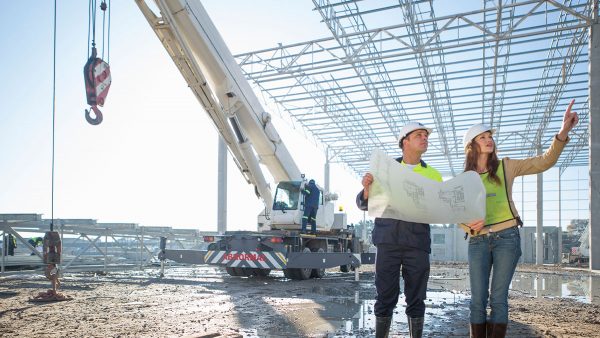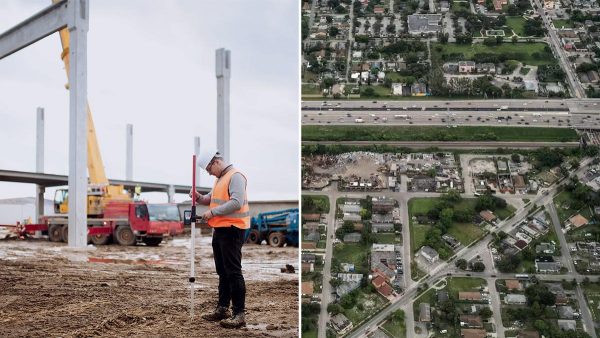
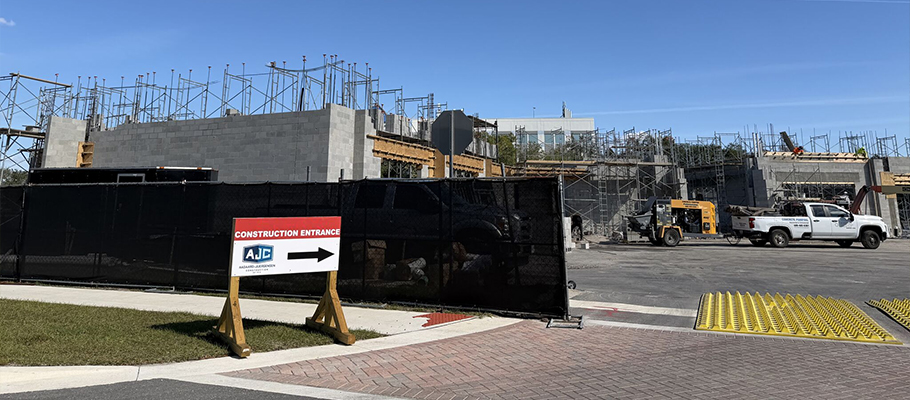
Commercial construction is the process of building, renovating, or improving structures used for business, public, or institutional purposes. It includes offices, retail centers, warehouses, healthcare facilities, and more. If a building supports commerce, services, or public use, it typically falls under commercial construction.
We’ve been building commercial projects here in Central Florida since 1970. Over the years, we’ve learned one thing for sure: commercial construction comes with bigger teams, stricter regulations, and higher stakes. There’s more coordination, more compliance, and more moving parts.
In this article, we’ll break down the commercial construction industry in clear, practical terms. We’ll cover the types of commercial construction projects, the different levels and project sizes, the common materials used in commercial construction, and the key requirements and regulations you need to understand before getting started.
Key Takeaways
- Commercial construction involves buildings used for business or public services.
- It includes new construction, renovations, build-outs, and expansions.
- Projects range from small retail suites to large industrial facilities.
- Codes, zoning, ADA, and fire safety requirements are critical.
- The right commercial contractor makes the difference in schedule, budget, and long-term quality.
What Is Commercial Construction Summary Overview
| Category | Summary |
|---|---|
| Definition | Commercial construction involves building, renovating, or expanding structures used for business, institutional, or public purposes. |
| Common Building Types | Office buildings, retail centers, warehouses, healthcare facilities, hospitality properties, religious buildings, mixed-use developments. |
| Project Types | New construction, renovations, tenant build-outs, and expansions or additions. |
| Typical Project Size | Small: under 5,000 sq. ft. • Mid-size: 5,000–20,000 sq. ft. • Large-scale: 20,000+ sq. ft. (Ranges are informal and vary by market and building type.) |
| Governing Codes | State and local building codes, zoning ordinances, ADA (Americans with Disabilities Act), fire safety codes, and OSHA worker safety regulations. |
| Key Materials Used | Reinforced concrete, structural steel, masonry (CMU), pre-engineered metal systems, fire-rated assemblies, glass systems. |
| Primary Phases | Preconstruction → Design → Permitting → Procurement → Construction → Inspections & Closeout |
| Industry Professionals Involved | Owner/developer, architect, engineers, general contractor, subcontractors, inspectors. |
| Timeline Range | Small renovations: 2–6 months • Mid-size projects: 6–12 months • Large developments: 12–24+ months |
| What Makes It Different From Residential | Higher occupancy loads, stricter life-safety requirements, complex mechanical systems, commercial zoning regulations, and larger project teams. |
Commercial Construction Definition
Commercial construction is the construction of buildings intended for commercial use, such as offices, retail stores, warehouses, medical facilities, and hospitality spaces. These projects must meet commercial building codes and safety regulations that are more complex than residential standards.
If you want a deeper breakdown of how commercial projects differ from housing developments, take a look at our guide on residential construction vs commercial construction. The regulations, scale, and coordination are very different.
At AJ Construction, we handle commercial projects across Central Florida. That includes everything from preconstruction planning to full design-build delivery. Commercial construction isn’t just about putting up walls. It’s about building functional spaces that meet strict compliance requirements and perform long-term.
What Is Considered Commercial Construction?
Commercial construction includes any building project intended for business, government, industrial, healthcare, or public use. If a structure serves commerce or public occupancy, it is generally classified as commercial.
If you’re unsure how a property is categorized, our article on what is a commercial building explains how occupancy and use determine classification.
There are also quality-based classifications that affect value and investment standards. You can explore those in our guide to commercial building classes (Class A, B, C, and more).
Here’s a quick breakdown:
| Building Type | Commercial? | Notes |
|---|---|---|
| Office Building | Yes | Business operations |
| Retail Store | Yes | Public access & sales |
| Warehouse | Yes | Storage or distribution |
| Restaurant | Yes | Food service & occupancy |
| Hospital | Yes | Healthcare facility |
| Single-Family Home | No | Residential classification |
| Apartment Complex | Often Yes | Multi-family usually commercial under building codes |
Understanding classification matters because it affects zoning, building code requirements, and permitting.
If a property is misclassified, it can lead to concrete problems such as costly redesigns, permit denials, or even a construction halt. For example, using the wrong building classification might result in a six-month permit delay or require $50,000 worth of architectural changes to meet the proper codes. Getting classification right up front saves time, money, and frustration down the road.
What Is the Commercial Construction Industry?
The commercial construction industry is the network of professionals, companies, and regulatory bodies involved in designing, building, and delivering commercial projects. It includes developers, architects, engineers, contractors, subcontractors, suppliers, inspectors, and municipalities.
Here’s who’s typically involved:
| Role | Responsibility |
|---|---|
| Owner / Developer | Funds and initiates the project |
| Architect | Designs the building |
| Engineer | Designs structural and mechanical systems |
| General Contractor | Manages construction execution |
| Subcontractors | Perform trade-specific work |
| Building Officials | Enforce codes and inspections |
It’s a coordinated effort. No commercial project gets built by one company alone.
At AJ Construction, we operate as a general contractor and design-build partner. That means we coordinate every moving part, from early preconstruction planning to final inspections.
After all these years, we know commercial construction is about teamwork. When the team is aligned, projects move smoothly. When they’re not? That’s when delays and budget issues show up.
Commercial Construction Examples
Commercial construction covers a wide range of industries and building types. These projects vary in size, complexity, and use.
Here are some examples:
- Office buildings
- Retail centers and shopping plazas
- Industrial and manufacturing facilities
- Warehouses and distribution centers
- Healthcare clinics and medical offices
- Hospitality buildings (hotels and restaurants)
- Religious facilities
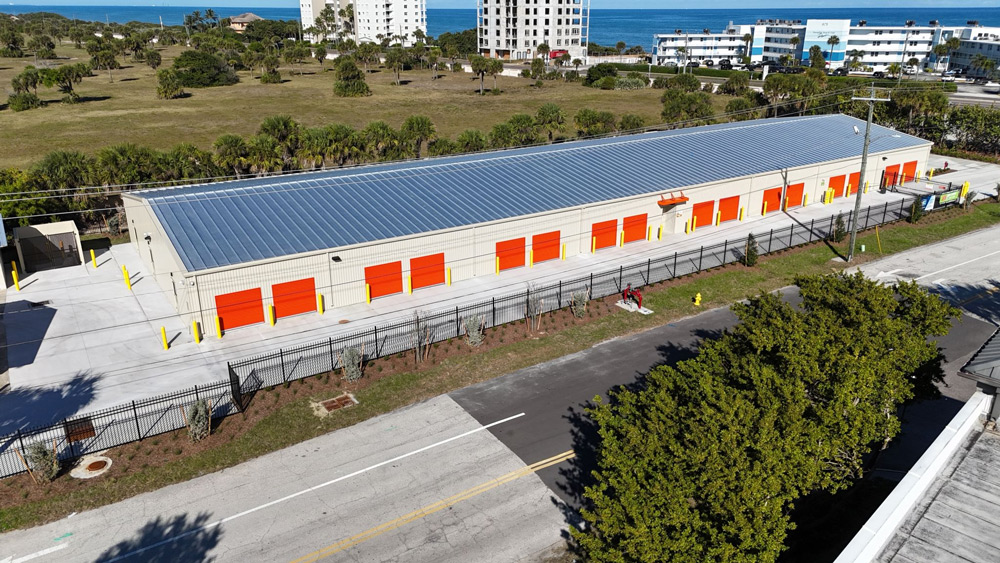
- Self-storage buildings
- Automotive dealerships and service centers
If you’d like a detailed breakdown by use type, see our guide on types of commercial buildings.
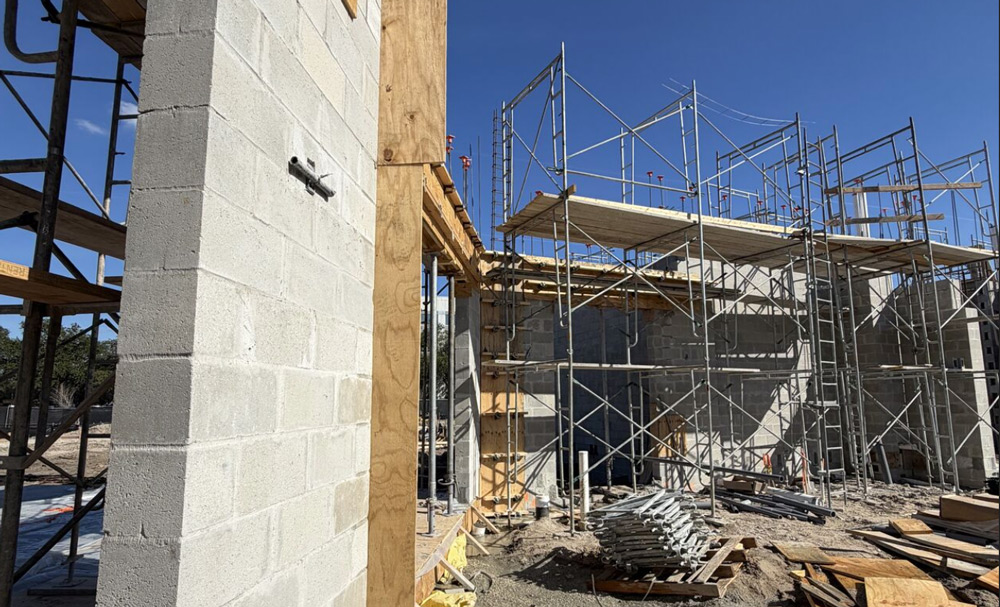
At Aagaard-Juergensen Construction, we’ve built across nearly every commercial sector in Central Florida. Each industry has unique requirements. A medical office isn’t built like a warehouse. A self-storage facility isn’t built like a hospitality space. That’s where experience matters.
Types of Commercial Construction Projects
Commercial construction projects fall into four main categories: new construction, renovations, tenant build-outs, and expansions. Each type involves different levels of planning, permitting, and coordination.
If you want a deeper dive into how each project type works, visit our full breakdown of types of commercial construction projects.
Let’s break them down.
New Commercial Construction
New commercial construction involves building a structure from the ground up on undeveloped or cleared land. These projects require site development, utilities, foundation work, and full structural construction.
This is the most complex type of commercial project. It involves:
- Land development
- Civil engineering
- Structural systems
- Full permitting
- Utility coordination
These projects demand strong preconstruction planning and budget control. That’s why services like preconstruction and design-build delivery are so important. In fact, robust preconstruction planning can often reduce total project costs by as much as 5 to 10 percent, thanks to more accurate budgeting, early problem-solving, and efficient scheduling. This kind of savings turns preconstruction from a theoretical benefit into real dollars for your project.
If you’re curious about the full step-by-step process, our guide walks through each phase.
Commercial Renovations and Remodels
Renovations improve or modernize an existing commercial building without completely rebuilding it. These projects may include structural updates, layout changes, system upgrades, or cosmetic improvements.
Renovations often happen while the business stays operational. That means:
- Careful scheduling
- Noise control
- Safety barriers
- Tight coordination
In these projects, it’s not just about construction. Usually, the spaces are occupied during renovations. That’s why we focus on minimizing disruption so the businesses can keep open and the customers or patients feel safe and respected. For example, we stage our work to maintain access for employees and visitors, install temporary barriers for dust and noise control, and communicate schedules clearly so everyone knows what to expect. We understand that renovating an active space means managing the experience for people, not just the building.
Tenant Build-Outs
Tenant build-outs customize interior commercial spaces for new tenants. These projects are common in office parks, retail centers, and mixed-use developments.
A build-out typically includes:
- Interior partitions
- Electrical and plumbing installation
- HVAC adjustments
- Flooring and finishes
This is one of the most common commercial project types we see in Central Florida.
Expansions and Additions
Expansions increase the size or capacity of an existing commercial building. This might involve adding square footage, extending warehouse space, or building a new wing.
These projects require:
- Structural tie-ins
- Utility expansion
- Updated permitting
- Possible code upgrades
Additions must integrate seamlessly with the existing structure.
Levels and Sizes of Commercial Construction Projects
Commercial construction projects vary in size, budget, and complexity. As project size increases, so does the number of management layers involved. For example, a small renovation might be led by a project manager, but mid-size and large-scale projects bring on dedicated roles like a project executive, scheduler, and safety manager. Larger teams also mean multiplied coordination with specialized subcontractors and consultants.
This is why fees and timelines rise with project scale: each additional square foot not only adds complexity in the field, but also brings more professionals onto your project team, all working together to deliver on schedule and within budget. Understanding the scale of your project helps set realistic expectations for timeline, cost, and team structure.
Here’s how we typically categorize them.
Small-Scale Commercial Projects
Small-scale commercial projects typically involve limited structural changes and straightforward building systems. These projects are often interior-focused and move faster through permitting and construction.
Common examples:
- Interior office remodels
- Small retail build-outs
- Restaurant renovations
- Minor warehouse improvements
Typical characteristics:
| Factor | Small-Scale Project |
|---|---|
| Approximate Size | Under 5,000 sq. ft. |
| Typical Budget Range | Under $1 million (varies by region) |
| Common Examples | Retail suites, restaurant build-outs, small offices |
| Structural Scope | Minimal structural modification |
| Mechanical Systems | Standard HVAC, electrical, plumbing |
| Permitting Complexity | Single jurisdiction review |
| Typical Timeline | 2–6 months |
| Risk Level | Low to moderate |
These projects still require proper planning. Even a small restaurant renovation must meet ADA, fire, and health department standards.
Mid-Size Commercial Projects
Mid-size commercial projects typically range from 5,000 to 20,000 square feet. These often include new standalone buildings or significant expansions.
Examples:
- Medical office buildings
- Multi-tenant retail plazas
- Automotive service centers
- Self-storage facilities
Typical characteristics:
| Factor | Mid-Size Project |
|---|---|
| Approximate Size | 5,000–20,000 sq. ft. |
| Typical Budget Range | $1 million – $10 million |
| Common Examples | Medical offices, automotive facilities, small warehouses, multi-tenant retail |
| Structural Scope | Steel or reinforced concrete framing |
| Mechanical Systems | Multi-zone HVAC, fire suppression systems |
| Permitting Complexity | Multi-discipline review |
| Typical Timeline | 6–12 months |
| Risk Level | Moderate |
At this level, coordination becomes critical. You’re dealing with structural engineers, civil engineers, mechanical systems, and often multiple inspections throughout the build.
Large-Scale Commercial Developments
Large commercial developments typically exceed 20,000 square feet and involve complex structural systems, major site development, and phased construction.
Examples:
- Industrial manufacturing facilities
- Distribution centers
- Large healthcare facilities
- Hospitality developments
Typical characteristics:
| Factor | Large-Scale Development |
|---|---|
| Approximate Size | 20,000+ sq. ft. |
| Typical Budget Range | $10 million+ |
| Common Examples | Industrial facilities, distribution centers, healthcare campuses, hospitality developments |
| Structural Scope | Heavy steel, tilt-wall, reinforced concrete |
| Mechanical Systems | Advanced HVAC, backup power, specialized systems |
| Permitting Complexity | Extensive regulatory review |
| Typical Timeline | 12–24+ months |
| Risk Level | High |
These projects demand experienced construction management. At this level, small mistakes become expensive. Budget control, scheduling, subcontractor coordination, and safety oversight all become magnified. Detailed preconstruction planning and risk management are essential.
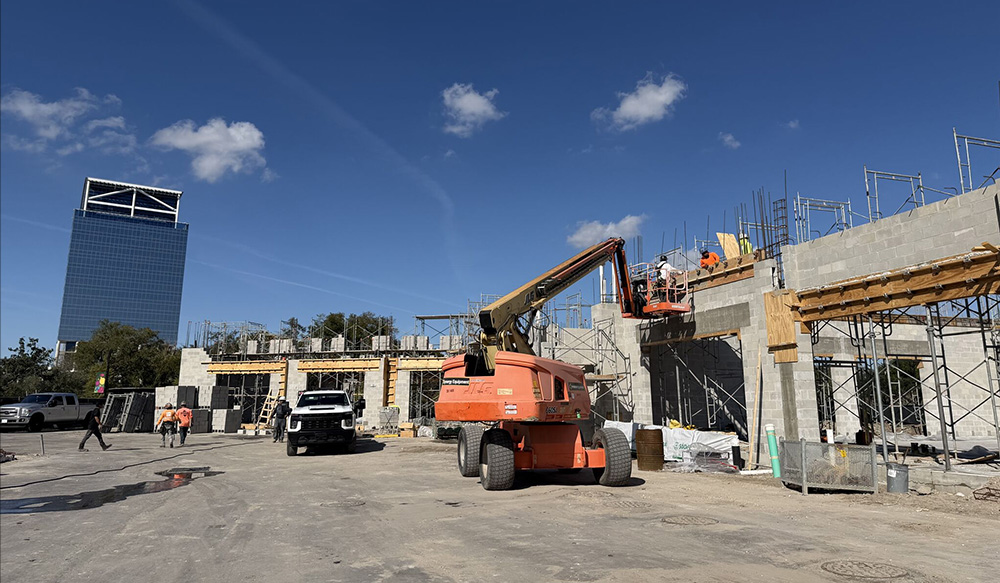
Common Materials Used in Commercial Construction
Commercial construction relies on durable, code-compliant materials designed to handle higher occupancy loads, stricter fire ratings, and long-term performance. Material selection affects cost, schedule, maintenance, and safety.
Here are the most common materials used on commercial projects:
| Material | Primary Use | Why It’s Used |
|---|---|---|
| Concrete | Foundations, slabs, tilt-wall panels | Strength, fire resistance, longevity |
| Structural Steel | Framing systems | High strength-to-weight ratio |
| Masonry (CMU) | Exterior & load-bearing walls | Durable, cost-effective |
| Pre-Engineered Metal | Warehouses, storage, industrial | Speed of construction |
| Glass & Curtain Wall | Office & retail facades | Natural light & aesthetics |
| Gypsum Board | Interior partitions | Fire-rated assemblies |
Concrete and steel dominate commercial builds because they meet structural load requirements and fire codes more effectively than wood framing.
You can learn more about how structural systems differ in our article on commercial building construction types.
Material selection isn’t just about price. It’s about long-term performance and compliance.
The Commercial Construction Process
The commercial construction process follows a structured sequence from planning through closeout. Each phase builds on the previous one to control risk, cost, and timeline.
Here’s a typical construction timeline:
1. Preconstruction & Planning
Budgeting, scheduling, feasibility studies, and site analysis happen during this phase. This is where smart decisions save money later.
2. Design & Engineering
Architects and engineers develop drawings and specifications. Structural, mechanical, electrical, and plumbing systems are coordinated.
3. Permitting & Approvals
Plans are submitted to local authorities. Building officials review for code compliance.
4. Procurement
Here, materials are ordered, subcontractors are contracted, and long-lead items are secured.
5. Construction Phase
In this phase, site work, foundation, framing, utilities, and interior systems are completed.
6. Inspections & Closeout
When final inspections occur, punch list items are resolved, and certificates of Occupancy are issued.
Commercial projects require constant coordination during this process. That’s why construction management and experienced general contracting matter so much.
Commercial Construction Requirements and Regulations
Commercial construction projects must comply with national, state, and local regulations designed to ensure safety, accessibility, and structural integrity. These requirements are more complex than residential standards due to higher occupancy loads and public use.
If you want a detailed look at structural and safety standards, review our guide on building codes for commercial buildings.
Land use classification is equally important. Our article on commercial zoning: classification, restrictions & codes explains how zoning impacts what can be built and where.
Here are the core regulatory areas:
| Requirement | Governing Authority | Purpose |
|---|---|---|
| Building Code | State & Local Building Departments | Structural integrity & life safety compliance |
| Zoning | Local Municipality | Land use & building classification |
| ADA | Federal Law (Americans with Disabilities Act) | Accessibility standards |
| Fire Code | Local Fire Authority | Fire prevention & suppression systems |
| OSHA | Federal Agency | Worker safety regulations |
Commercial projects must meet structural, fire-resistance, energy efficiency, and accessibility standards based on their occupancy classification.
You can’t cut corners here. Inspections are mandatory, documentation is detailed, and planning ahead prevents costly delays.
Why Commercial Construction Requires an Experienced Contractor
Commercial construction involves more coordination, higher risk, and stricter compliance than residential work. An experienced contractor helps manage complexity, control costs, and protect the project schedule.
Here’s what experience brings:
- Accurate budgeting through preconstruction planning
- Clear scheduling and milestone tracking
- Subcontractor coordination
- Code compliance management
- Safety oversight
- Transparent cost reporting
At Aagaard-Juergensen Construction, we’ve been building in Central Florida since 1970. One of our core values is to operate on an open-book basis. That means our clients see the numbers; no surprises, and no guesswork.
Commercial construction isn’t just about building a structure. It’s about building it correctly, safely, and efficiently.
Commercial Construction FAQs
What is commercial construction?
Commercial construction is the process of building or renovating structures used for business, public, or institutional purposes. These projects must meet commercial building codes, fire safety regulations, and accessibility standards that are more complex than residential construction.
In short, if a building is designed to operate a business or serve the public, it falls under commercial construction.
For a broader breakdown of property classification, see what is a commercial building.
What is considered commercial construction work?
Commercial construction work includes new builds, renovations, expansions, and tenant improvements for offices, retail centers, warehouses, healthcare facilities, restaurants, and similar properties. It also includes site development, structural upgrades, and system improvements tied to business or public use.
If the occupancy type is classified as business, mercantile, industrial, healthcare, or assembly under applicable state or local building codes, it is considered commercial construction.
For a deeper look at how properties are categorized, refer to our guide on commercial building classes.
What is light commercial construction?
Light commercial construction refers to the construction, renovation, or build-out of smaller, low-rise business buildings. These projects typically involve single-story or multi-story structures under 20,000–25,000 square feet, with less structural complexity than large industrial or high-rise developments.
In simple terms, it’s commercial construction on a more manageable scale.
Light commercial projects still require full code compliance, including ADA accessibility, fire protection systems, and local building inspections. The difference is in scope and complexity, not in standards.
Common Examples of Light Commercial Construction:
- Small office buildings
- Standalone retail stores
- Restaurants
- Banks
- Small medical clinics
- Professional service offices
Key Characteristics
| Factor | Light Commercial Construction |
|---|---|
| Typical Height | 1–3 stories |
| Approximate Size | Under 25,000 sq. ft. |
| Structural Systems | Steel framing, masonry, or light concrete |
| Project Timeline | Often 3–9 months |
| Complexity Level | Moderate |
Light commercial doesn’t mean “easy.” It still requires coordination between architects, engineers, inspectors, and contractors. It just doesn’t carry the same structural demands as a 200,000-square-foot industrial facility.
What industries fall under commercial construction?
Commercial construction serves industries that require buildings for business operations, public access, services, or revenue-generating activity. These facilities are designed for occupancy, functionality, and long-term operational performance.
Common industries include:
| Industry Category | Example Facilities | Typical Project Characteristics |
|---|---|---|
| Office | Corporate offices, business parks, multi-tenant buildings | Interior build-outs, structured parking, multi-floor layouts |
| Retail & Hospitality | Shopping centers, standalone retail, restaurants, hotels | High public occupancy, storefront systems, specialized finishes |
| Healthcare | Medical offices, clinics, outpatient centers | Strict code compliance, specialized mechanical systems |
| Institutional | Schools, universities, government buildings, religious facilities | Assembly occupancy, life-safety systems, phased construction |
| Recreational & Sports | Gyms, fitness centers, athletic complexes | Open-span structural systems, high ceiling requirements |
| Warehousing & Storage | Distribution centers, self-storage facilities | Large footprint, steel framing, loading docks |
| Mixed-Use Developments | Combined retail, office, and residential spaces | Integrated utilities, phased delivery, complex zoning |
At AJ Construction, we’ve built across most of these sectors throughout Central Florida. If you would like to see some examples of commercial projects by industry, visit our portfolio.
Want to learn more? Visit our article about types of commercial buildings.
How long does a commercial construction project take?
The timeline of a commercial construction project depends on project size, complexity, permitting requirements, and material availability. Smaller renovations may take 2–6 months, while large ground-up developments can take 12–24 months or more.
Here’s a general breakdown:
| Project Type | Typical Duration |
|---|---|
| Small Renovation | 2–6 months |
| Mid-Size New Build | 6–12 months |
| Large Development | 12–24+ months |
Proper preconstruction planning significantly improves schedule accuracy.
Conclusion
Commercial construction is more than just building walls and pouring concrete. It’s a coordinated process that brings together planning, engineering, compliance, budgeting, and skilled execution.
Whether it’s a retail build-out, a new warehouse, or a medical office facility, commercial construction requires experience, attention to detail, and strong project management.
Commercial construction is complex. It’s not just about the building itself; it’s about navigating site conditions, code requirements, and permitting processes that add another layer of coordination. That’s exactly why working with an experienced commercial contractor matters.
Ready to Start Your Commercial Project?
If you’re planning a commercial construction project in Orlando, Central Florida, our team at AJ Construction is here to guide you through every phase, from preconstruction and design-build to final inspections.
Our Orlando construction firm operates with transparency. We prioritize safety, and we focus on delivering quality that lasts.
Let’s talk about your project. Contact AJ Construction today by calling 407-298-1550 or by filling out a contact form.